
Field note / Gas evacuation
Getting gas to market: pipeline injection or mobile cascades.
Why evacuation is a siting decision as much as an engineering one.
The routes to market
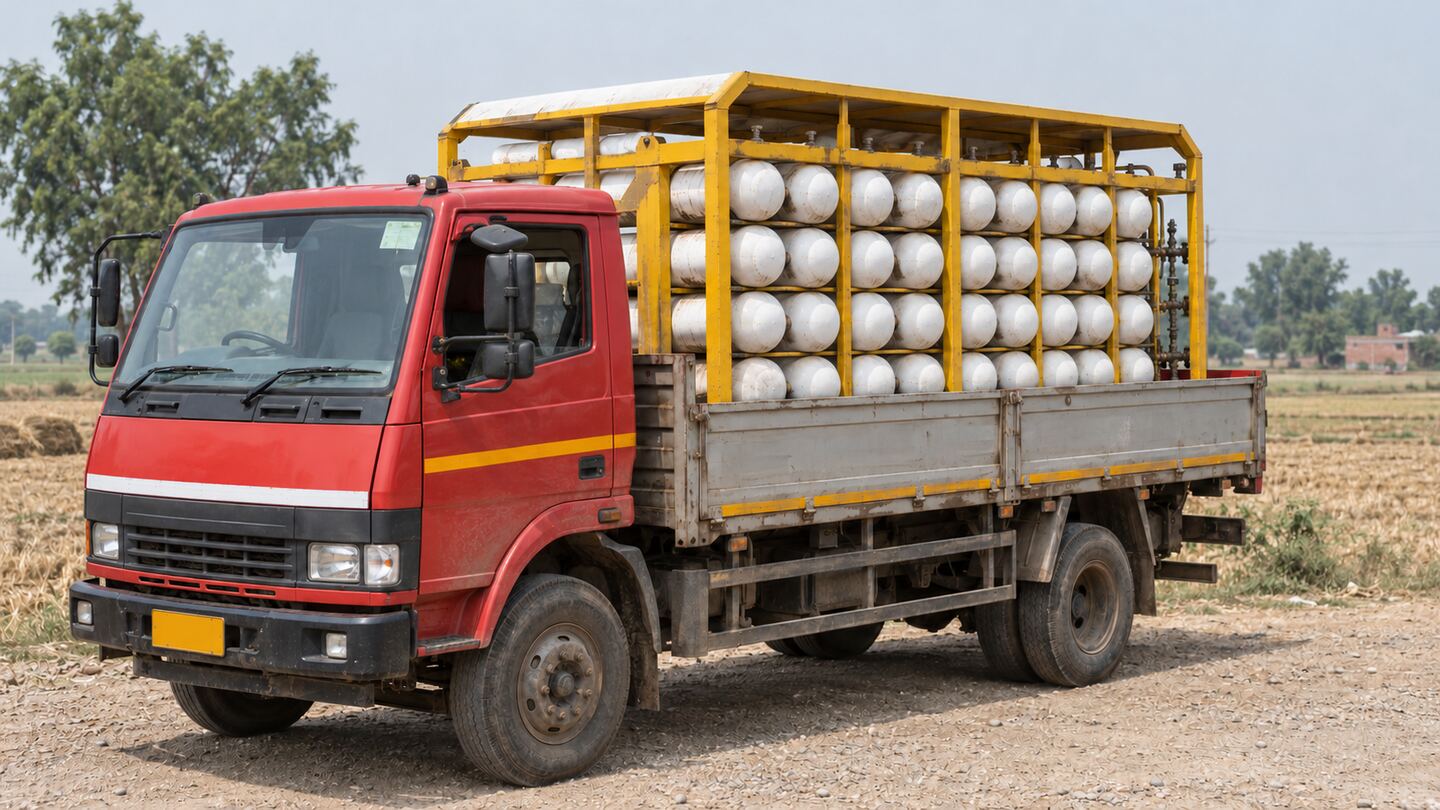
CBG reaches market in one of two ways: injected into a natural gas pipeline or a city gas network, or compressed into mobile cascades and trucked. The regulator's injection guidelines cover both routes.
The Petroleum and Natural Gas Regulatory Board approved these guidelines after a technical committee, a public draft and an open house, to make grid-based evacuation of CBG workable.
Pipeline or city gas injection
This route works when a compatible network is within reach and will accept the gas.
Injection pressure is agreed between the producer and the network operator, and must stay within the pipeline's maximum allowable operating pressure.
For a polyethylene (MDPE) city gas network the guideline indicates about 3–5 bar, or whatever the network requires. Steel networks take gas at their own operating pressure.
A typical injection point uses a pressure-regulating skid with a gas filter, active-monitor pressure reduction with a slam-shut valve, isolation valves and a non-return valve.
Pipeline injection uses a twin-stream metering skid with data shared with the operator. Cascade supply is metered at both the loading and the delivery point.
Odorisation depends on the receiving network: it is not required for injection into steel trunk pipelines, but is required where polyethylene pipe is laid. City gas injection and cascade supply include odorant dosing.
Mobile cascades
For cascades, the producer compresses CBG to 200–250 bar.
Gas delivered by cascade can supply a CNG station directly, or a decompression unit that injects it into a city gas network.
Cascade-fed injection needs a decompression skid, which may need a water heater to offset the cooling that comes with pressure reduction.
Distance, volume and acceptance
Cascades add compression, trucking and handling for every unit of gas, so they can suit early volumes or sites far from a network.
Route economics depend on connection distance, compression requirements, throughput, network acceptance and transport arrangements. We have not established the preferred route.
Quality is part of the route
Injected gas must meet the applicable regulatory access code and the Bureau of Indian Standards biomethane specification, whichever is more stringent.
Injected gas must have hydrocarbon and water dew points no higher than 0 °C at pipeline operating pressure, and a gas temperature no higher than 55 °C.
Producers must run online gas-quality analysers, including moisture and hydrogen sulphide, sampling at least every 5 minutes, with the data shared with the network operator.
An automatic interlock cuts gas flow if quality goes out of specification. Isolation also triggers on pressure deviation, odorisation failure, analyser power loss, methane detection or an emergency stop.
Fixed methane detectors raise an alarm above 20% of the lower explosive limit and automatically isolate gas flow above 40%.
Injection facilities follow the regulator's technical-standard and integrity-management regulations. Mobile-cascade dispensing also follows retail-outlet safety rules, road-transport guidelines for hazardous gases and the gas cylinder rules administered by the Petroleum and Explosives Safety Organisation.
Support for connecting pipelines
GOBARdhan is a national scheme approved by the Union Cabinet and run by the Ministry of Petroleum and Natural Gas. It builds on the earlier SATAT, pipeline-connectivity, biomass-aggregation, manure-assistance and central-assistance schemes and brings them onto one platform across the CBG value chain.
The national GOBARdhan scheme supports both cluster-based and standalone pipelines connecting CBG plants to trunk pipelines and city gas networks.
Scheme support does not make connectivity automatic or assure offtake. Eligibility and connection conditions still need to be checked.
Open questions
What we don't know yet
- Which route our first project will use.
- Whether a nearby network can accept gas year-round, and at what pressure.
- How scheme eligibility and support conditions apply to a given connection; operational guidelines have not yet been checked against a primary copy.
- The biomethane specification’s detailed clause values, which are not publicly accessible.
- The cost difference between routes at our scale.
Sources
Petroleum and Natural Gas Regulatory Board
Published · Accessed
Petroleum and Natural Gas Regulatory Board
Published · Accessed
Press Information Bureau / Ministry of Petroleum and Natural Gas
Cabinet decision release on the GOBARdhan scheme
Published · Accessed